Structure and lineaments
Can gold-bearing structures be read from satellite alone?
More confidently than any other free layer in this package — with one firm caveat.
Orogenic gold in Archaean greenstone belts is structurally controlled. The metal sits in and along shear zones, second- and third-order faults, fold hinges, and lithological contacts that acted as fluid plumbing during deformation. Those structures leave a topographic and a radar-texture signature that a free 30 m DEM and free Sentinel-1 SAR resolve below the scale of the 1:100 000 Geological Survey sheet, which is exactly the gap inside a 300 ha claim.
Satellite-alone gives you a defensible map of candidate structures: linear valleys, aligned drainage, breaks-in-slope, fold-shaped ridge curvature, and radar lineaments. What it does not give you is which of those structures is mineralized. A lineament is a candidate to walk and check against strike/dip readings. It is never a confirmed fault, and certainly never a confirmed gold-bearing fault.
Structure is the highest-signal, lowest-ambiguity free layer in this package. A topographic lineament has far fewer plausible non-geological explanations than a SWIR clay ratio does. Vegetation, laterite, and soil moisture wreck spectral indices in a tropical belt; they barely touch a DEM. SAR sees through cloud and, to a degree, through canopy.
Why structure matters for orogenic gold
Orogenic (lode, mesothermal) gold in the Zimbabwe Craton's Mberengwa/Belingwe greenstone belt is emplaced late in the deformation history, when metamorphic fluids migrate along the most permeable pathways available. Those pathways are structures:
- Second- and third-order structures — subsidiary shears, faults, and fractures branching off the belt-scale first-order shear. This is the scale that matters inside a claim and the scale the regional map misses. Dilational jogs and bends on these host the ore shoots.
- Fold hinges and closures — antiformal closures concentrate fluid; plan and profile curvature flags them from a DEM.
- Lithological contacts — the rheological contrast at ultramafic/mafic or BIF contacts localizes strain and hosts listwaenite-style alteration. Contacts often express as a break-in-slope or a drainage line.
- Structural intersections — where two trends cross is a classic high-grade target. Lineament intersections carry more weight than lineament length.
The practical exploration heuristic: map the structures, find the second-order splays and the intersections near a favourable lithology, then walk them. Free DEM and SAR let a zero-budget holder do the first two steps without geophysics or commercial software.
DEM-derived structure
Source and coverage
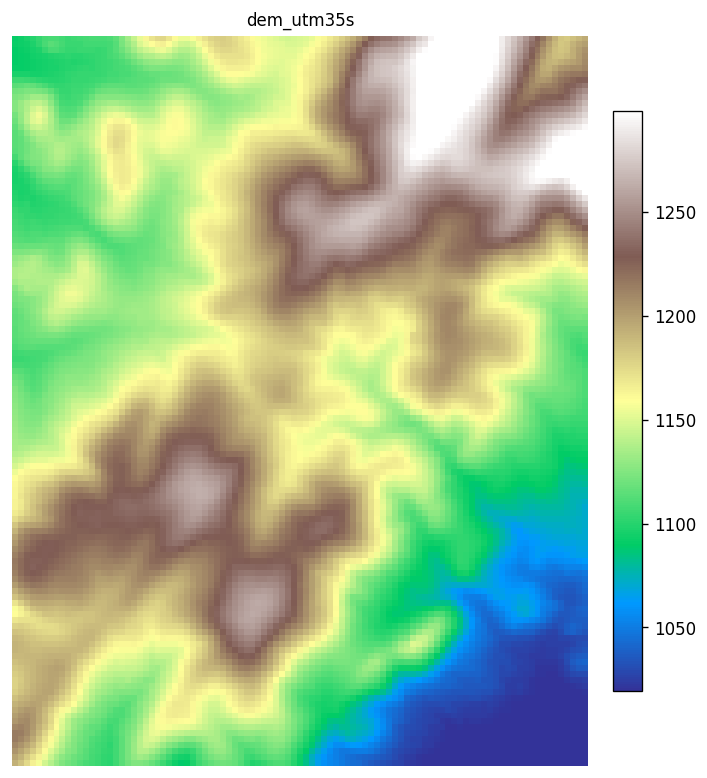
The AOI straddles the E029/E030 one-degree tile boundary at longitude 30.0, so both tiles are fetched from Copernicus GLO-30, reprojected from EPSG:4326 to UTM 35S (EPSG:32735) at 30 m, and mosaicked into a 123 x 97 pixel grid. Elevation ranges from 1006 m to 1341 m across the claim.
import folia

# fetch both tiles (AOI crosses the E029/E030 boundary at lon 30.0)
dem = folia.fetch(
    dataset="@esa/copernicus-dem/glo-30",
    aoi="research/mineral-prospecting/aoi.geojson",
    crs="EPSG:32735",   # reproject to UTM 35S before derivatives
    resolution=30,
)
Multi-azimuth hillshade
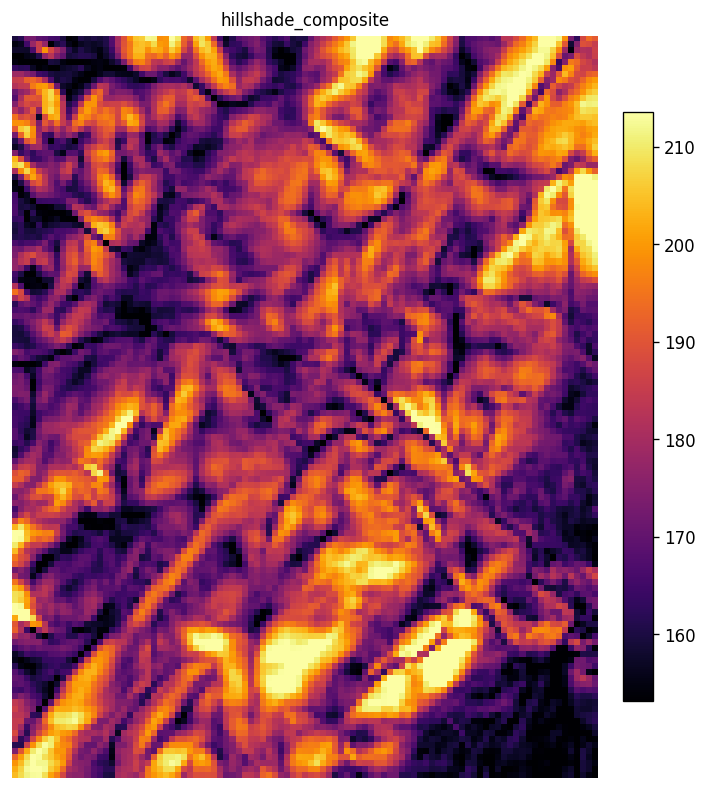
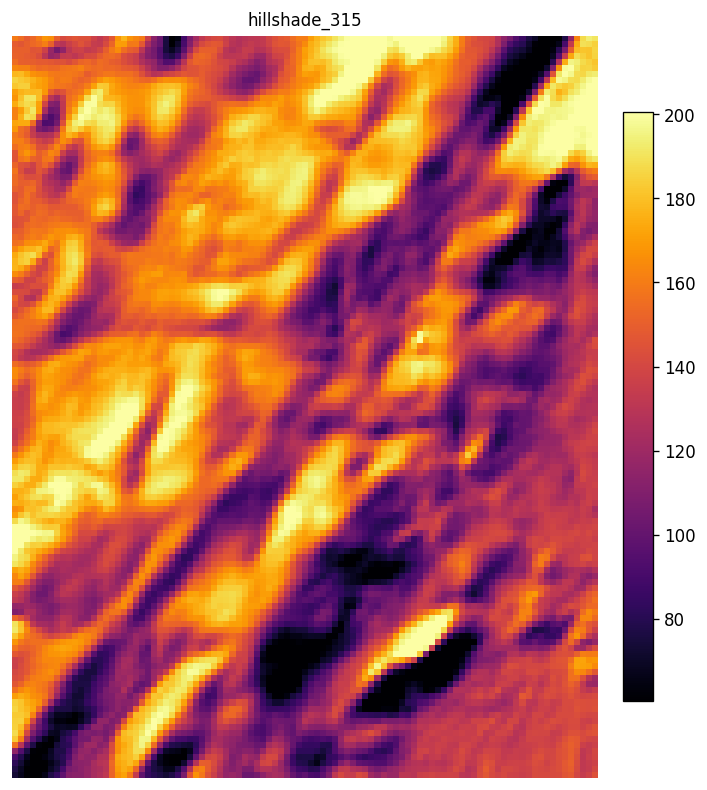
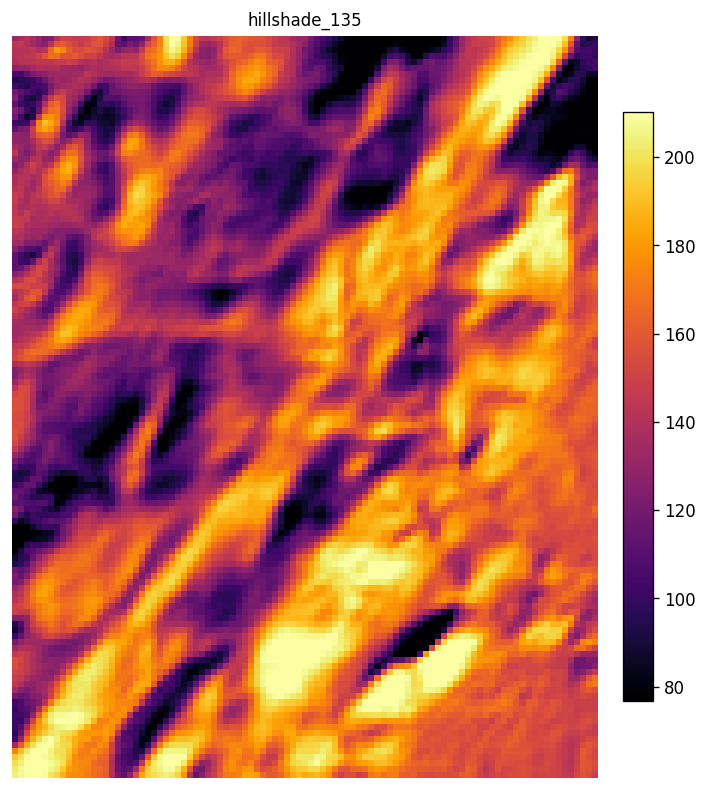
A single hillshade illuminates structures perpendicular to the sun direction and is nearly blind to structures parallel to it. The GIS default of 315 degrees (northwest) systematically under-detects NW-SE structures, which in many cratons is a principal ore-controlling trend.
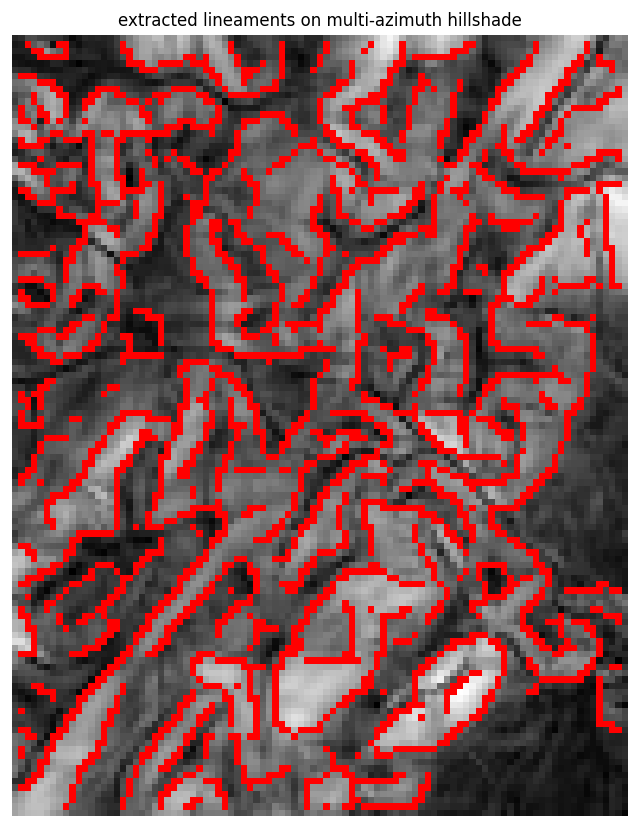
The fix is multi-azimuth illumination: render hillshades from four azimuths (315, 45, 135, 225 degrees, two orthogonal pairs), then combine them so every structural orientation is lit by at least one sun. The edge-strike rose for this AOI shows a dominant NW-SE trend at 135-150 degrees, a pattern the default single-azimuth hillshade systematically under-detects.
# multi-azimuth hillshade from dem_structure.py
azimuths = [315, 45, 135, 225]
hillshades = [compute_hillshade(dem, azimuth=az, altitude=35) for az in azimuths]
composite = np.max(np.stack(hillshades), axis=0)   # max-lit composite
Source: research/mineral-prospecting/structure-lineaments/dem_structure.py
Slope and curvature
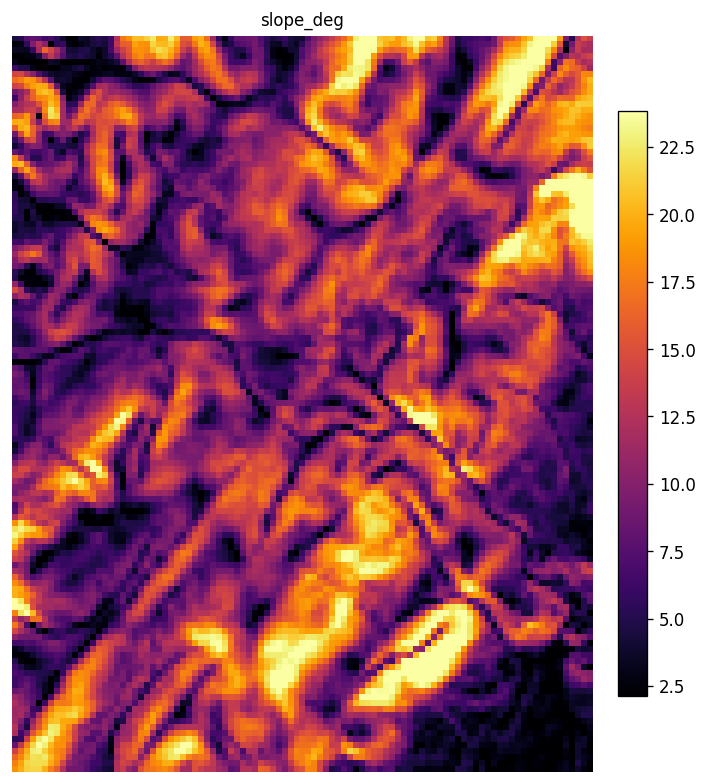
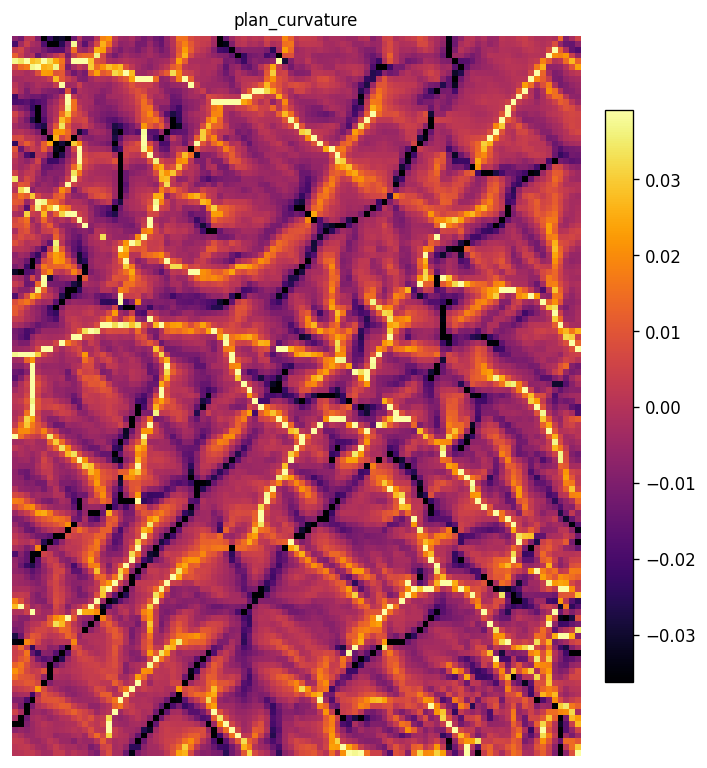
Faults and contacts often coincide with linear breaks-in-slope. Fold closures appear as curved arcs of high plan curvature. Profile curvature flags scarp edges and fold-limb-to-hinge transitions.
Lineament extraction
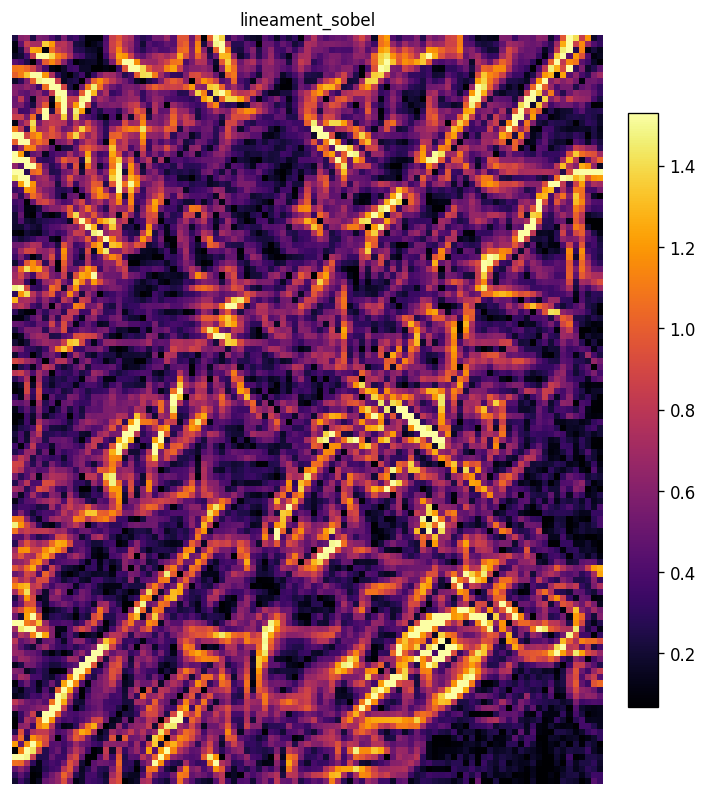
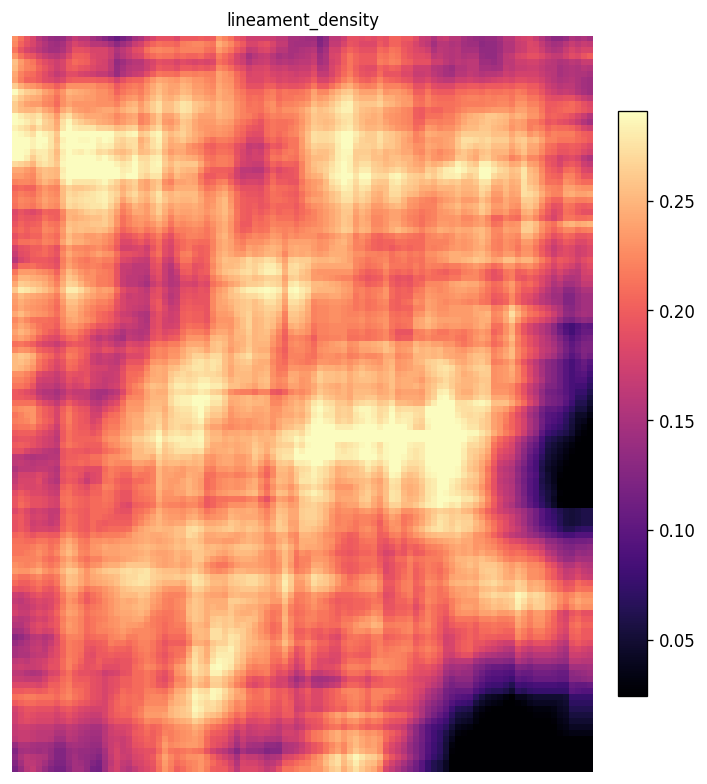
Lineaments are extracted by applying a Sobel gradient-magnitude operator to the multi-azimuth hillshade composite, then converting the edge map to vectorised segments. Density is computed as total lineament length per unit area, producing a heatmap of structural complexity. The method is the open-source equivalent of the PCI Geomatica LINE algorithm (Canny/Sobel edge detection, threshold, thin, link) used widely in the mineral-exploration literature.
Drainage as a structural proxy
Rivers exploit weakness: straight stream segments, abrupt right-angle bends, aligned valley reaches, and trellis/rectangular drainage patterns are textbook fault and fracture indicators. A first-order channel that runs straight for a kilometre is following something.
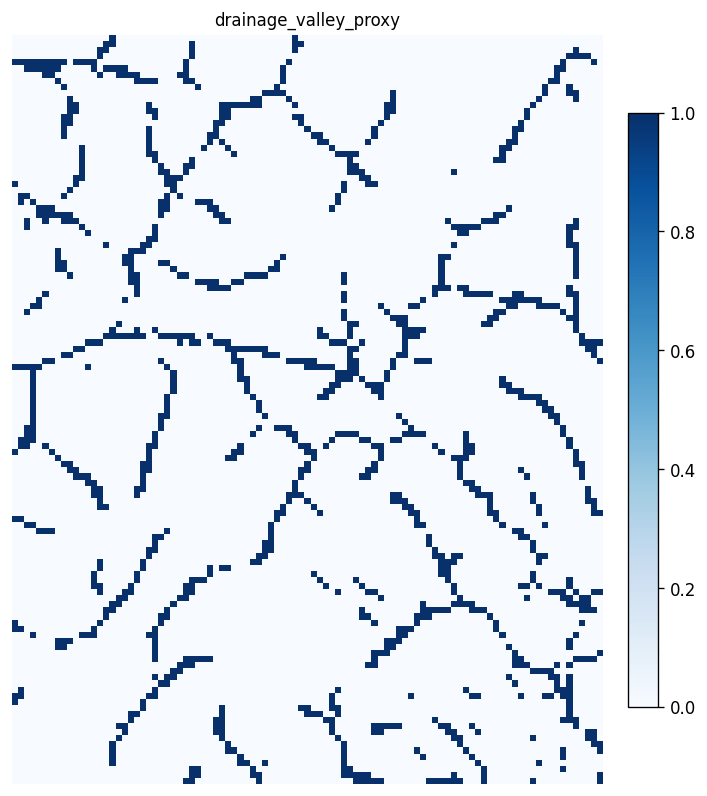
Anthropogenic false positives are the dominant confound. Roads, tracks, field edges, terraces, and fence-line erosion all make straight topographic lines. Cross-checking every candidate against optical imagery before calling it structural is mandatory.
SAR-derived structure (Sentinel-1)
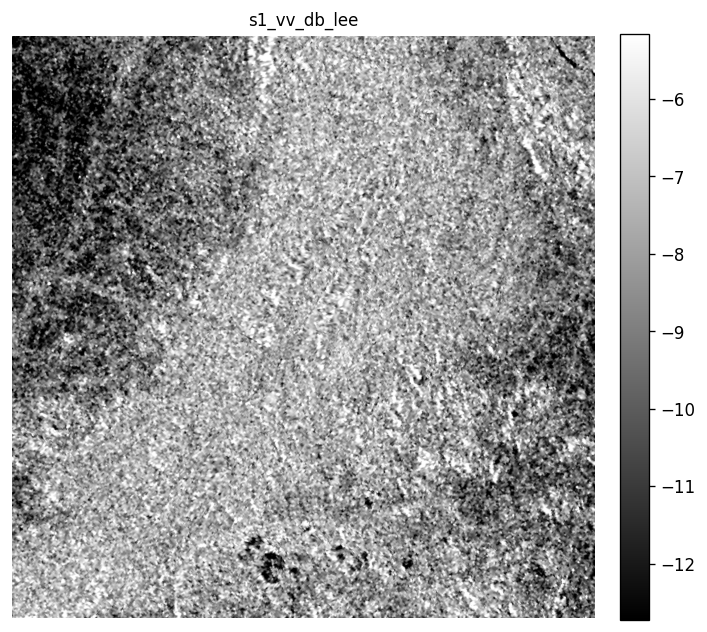
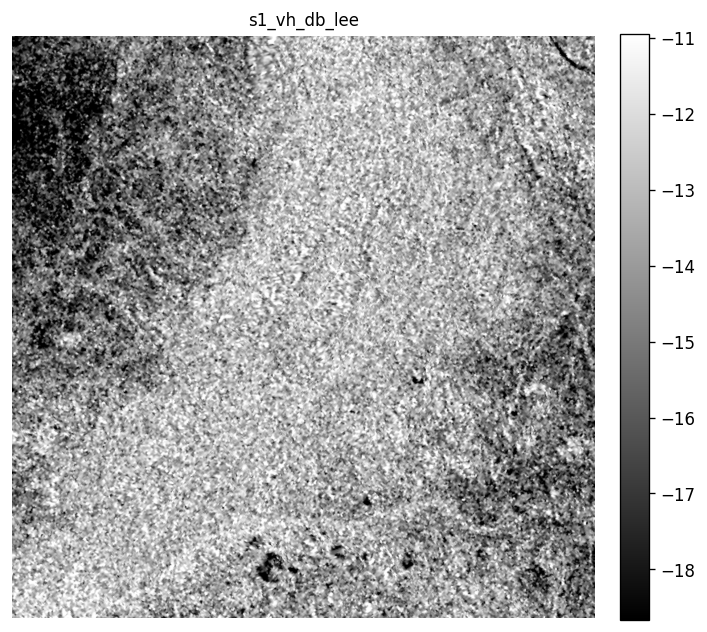
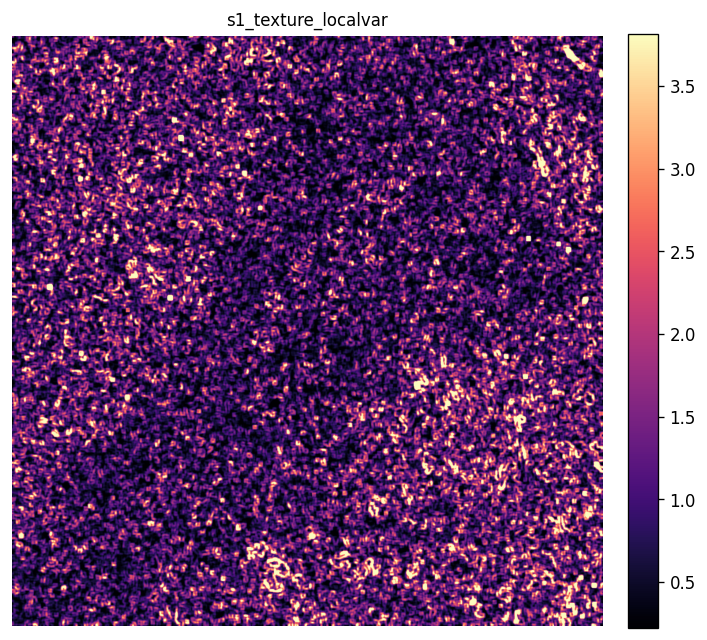
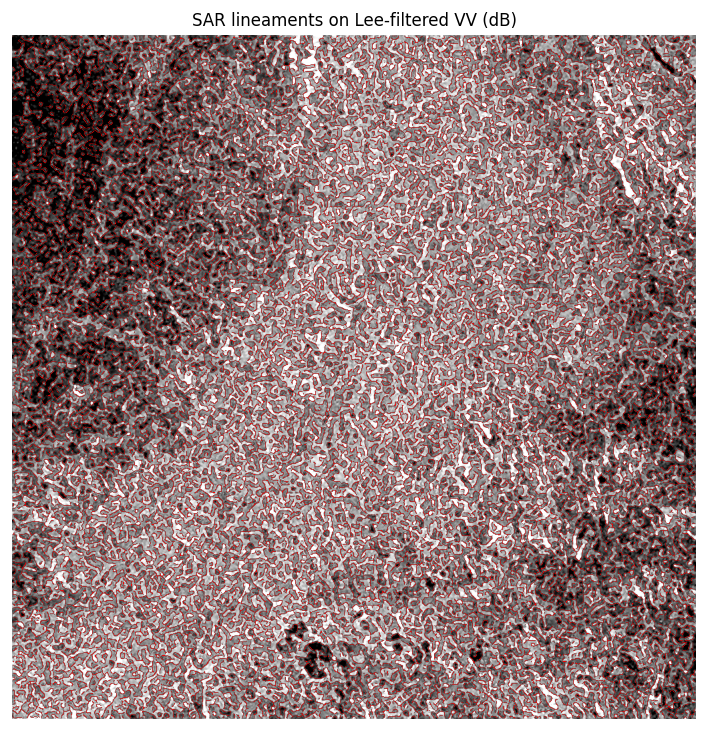
SAR adds an independent structural view with three properties that matter in this belt: it is cloud-proof and day/night capable; its side-looking geometry produces a built-in shaded-relief analog where slopes facing the radar appear bright; and the spatial texture of backscatter separates rough/blocky terrain (rock outcrop, scree along a scarp) from smooth terrain (soil, cultivated ground).
The data used here are Sentinel-1 RTC ascending orbit, 2026-06-21, already in UTM 35S at 10 m. No reprojection is needed.
s1 = folia.fetch(
    dataset="@esa/sentinel-1/rtc",
    aoi="research/mineral-prospecting/aoi.geojson",
    bands=["vv", "vh"],
    date="2026-06-01/2026-06-21",
    crs="EPSG:32735",   # already native; confirmed by inspection
)
Source: research/mineral-prospecting/structure-lineaments/sar_texture.py
Look-direction bias
SAR has a fixed look direction per orbit pass. Structures parallel to the look direction are foreshortened or invisible; structures perpendicular are enhanced. This is the direct analogue of the hillshade sun-azimuth problem. The mitigation is to combine ascending and descending passes (different look azimuths). This arm uses one scene to demonstrate the method; combining orbit directions is the next production step.
NISAR L-band: when it arrives
C-band (5.6 cm wavelength) backscatter is dominated by the canopy and the top of the vegetation/soil layer. Under closed tropical canopy, Sentinel-1 images the vegetation, not the rock beneath it. L-band (~24 cm, as on NISAR and ALOS-2 PALSAR) penetrates vegetation substantially better and interacts with the ground, trunks, and large branches, giving a structural read the C-band misses.
A coverage probe against the NISAR GCOV beta catalog
(NISAR_L2_GCOV_BETA_V1_1, window 2025-10 to 2026-06) returned 0 granules over
this AOI. The same search returns 20 beta granules globally, so this is a genuine
coverage gap, not a probe failure. Once commissioning coverage reaches this latitude
(-20 S), L-band will be the upgrade that sees structure under canopy.
Source: research/mineral-prospecting/structure-lineaments/nisar_coverage_check.py
ALOS PALSAR-2 mosaics offer free L-band coverage now for areas NISAR has not yet reached. They are a practical interim option for sub-canopy structural mapping and a natural next step once the C-band lineament map is validated against field observations.
Data upgrades, stress-tested (FABDEM, PALSAR-2)
The V1 structure arm used Copernicus GLO-30 (a Digital Surface Model that carries
roughly 10 to 20 m of miombo canopy over this belt) and Sentinel-1 C-band (which
images the canopy, not the rock). Two upgrades were the obvious next steps and were
promised in the V1 write-up: a bare-earth DEM (FABDEM) and L-band SAR (ALOS-2
PALSAR-2). Both were run end to end, on the identical pipeline, changing only the
input surface or radar band. The full stress test is in
research/mineral-prospecting/structure-lineaments/STRUCTURE_V2.md. The honest
headline: better data confirmed the structural read rather than changing it.
FABDEM bare-earth DEM: a correctness upgrade, adopted as canonical, that does not move the targets. FABDEM (Hawker et al. 2022) strips forest and buildings from GLO-30 to approximate bare ground. Running it through the same hillshade / Sobel / Canny / density pipeline, the canopy was demonstrably removed (maximum elevation dropped 12.3 m as the tree-top surface was pulled down to ground, while valley floors barely moved). And the structural read held: the dominant NW-SE trend stayed in the same 135 to 150 degree bin, the full azimuth rose correlated at 0.87, and the lineament-density highs (the where-to-walk heatmap) co-located at correlation 0.72. Individual lines reshuffle by a cell here and there (edge-mask IoU 0.37, the expected behaviour of edge detection on two slightly different surfaces), and FABDEM actually produced slightly more edges (+6.4%), not fewer, because the open miombo woodland here was never drawing many crisp forest-edge false scarps for it to remove. The conclusion: the lineaments are bare-earth structure, not canopy artifacts. FABDEM is now the canonical surface for this arm and feeds the fused priority map; swapping it in left the field-check targets essentially where they were. The structural conclusion is robust to the DEM choice.
PALSAR-2 L-band: texture corroboration only on this AOI, not sub-canopy structure. At roughly 24 cm wavelength, L-band penetrates canopy far better than C-band's 5.6 cm and is, in principle, the right tool to see structure under tropical cover. But the only free L-band over this claim is JAXA's 25 m annual mosaic, which composites many acquisitions across the year and so smears the per-acquisition radar look geometry. That look geometry is the exact mechanism that makes radar behave like shaded relief and carry lineaments; averaging many look directions averages it away. The result is a lineament map dominated by speckle and canopy-texture blobs rather than linear structure (equal- resolution edge density 0.46x the C-band map, IoU 0.16). So PALSAR-2 cannot deliver the sub-canopy structure its wavelength promises here. The HH, HV, and HH-HV cross-pol ratio remain useful as a cloud-proof roughness and canopy-separation texture layer, and that is how it is treated, but its lineament map is not structural evidence. The promise is recoverable with a single-look ALOS-2 or ALOS-4 scene, or with NISAR (open, frequent L-band revisit), neither of which is freely available over this AOI today. This upgrade is documented here; it does not add a map layer because it does not change the structural picture.
NICFI (Norway's International Climate and Forest Initiative high-resolution Planet basemaps) was considered for the optical cross-check but left off on license grounds: its terms do not permit republishing derived layers in this open reproduction, so it has no place in a re-runnable recipe.
The bottom line across both upgrades: the V1 structural read stands. The where-to-walk-first map is a DEM product, and it is stable whether you use the surface model or the bare-earth model. Neither radar band is the structural workhorse on this 300 ha AOI. The targets are robust to the DEM choice.
How to use these outputs
- Open the lineament-density heatmap and the multi-azimuth composite side by side. Density highs are structurally complex ground.
- Note the dominant trends. The edge-strike rose shows a NW-SE principal at 135-150 degrees; compare this to the belt's known structural grain on the Geological Survey sheet.
- Find intersections of two trends near a favourable lithology. These are the top-ranked walk targets.
- Overlay the drainage proxy. Straight or aligned channel reaches that co-locate with a lineament-density high reinforce it.
- Compare DEM and SAR lineament maps. Features that appear in both are more likely to be structural rather than anthropogenic.
- Cross every candidate against the holder's strike/dip readings (in-situ
structure.template.csv). A lineament whose azimuth matches a measured shear or fault strike is a calibrated candidate. One that does not match is either a different feature or a structure not yet logged. - Discard anything that is obviously a road or field edge in optical imagery.
Outputs are candidates to field-check, not faults. Nothing here says gold.
Limitations
| Layer | Limitation |
|---|---|
| DEM 30 m | Resolves only tens-of-metres topographic expression. Sub-tile fractures with no relief are invisible. |
| Anthropogenic false positives | Roads, tracks, field edges, terraces. The dominant DEM-lineament confound. Cross-check optical. |
| C-band canopy ceiling | Sentinel-1 under closed canopy images vegetation, not rock. |
| Single SAR scene / single orbit | One ascending scene; no descending pass to mitigate look-direction bias. |
| No mineralization signal | Structure narrows where to walk. The rock must be sampled to determine ore control. |
| Uncalibrated without in-situ data | The in-situ structural template is the calibration step; without it, all candidates are equal weight. |
The conversion from "lineament" to "ore control" is a field and sample job. This
page produces the where-to-walk map. The in-situ structural log
(research/mineral-prospecting/in-situ/) is where it gets calibrated against
measured strike, dip, and sample results.