Mineral prospecting on a shoestring
A registered gold claim sits in the Mberengwa (Belingwe) greenstone belt near Zvishavane, Zimbabwe. The holder has walked the ground, has the Geological Survey sheet, and has zero budget for trenching, geophysics, or commercial remote sensing. The question is not "can satellites find gold" (they cannot) but a narrower, answerable one: can free satellite and DEM data narrow ~300 hectares down to the few hundred metres worth sampling next?
This report works that question end to end on free, cloud-native data, with every
figure produced by a re-runnable folia.fetch recipe. It is organized as the
holder's three questions, plus two later arms: a multi-decadal disturbance time
series, and the one result here with measured skill, an AlphaEarth embedding analog
validated against the belt's known gold.
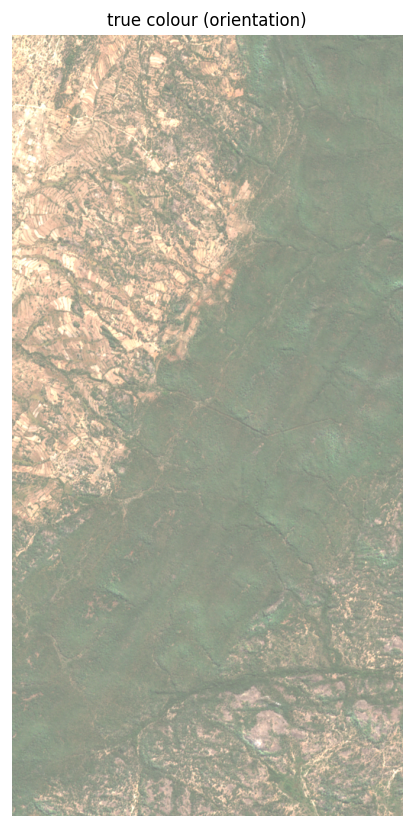
The location, and a correction worth seeing
The holder supplied corner coordinates labelled UTM Zone 36S. Taken at face
value, the claim centroid lands at ~36°E on the Mozambique coast, about 615 km
from Zvishavane. The eastings near 30°E are a Zone 35S signature: read as
EPSG:32735 the claim sits ~19 km north of Zvishavane, in the greenstone belt,
which the supplied geology sheet confirms. The Sentinel-2 tile that covers it is
T35KRT, MGRS zone 35, an independent check.
research/mineral-prospecting/aoi/build_aoi.py.
Data sources
All free. Tier-1 was already in the Folia catalog; Tier-2 was registered for this
report. Heavy reads use windowed folia.fetch (only the COG blocks touching the
AOI), so the whole study pulled about 15 MB, not gigabytes.
| Source | Folia id | Role |
|---|---|---|
| Sentinel-2 L2A | @esa/sentinel-2/l2a |
iron oxide, broad alteration, vegetation + cloud masks |
| Landsat C2-L2 | @usgs/landsat/c2-l2 |
cross-check; long historical record |
| Copernicus DEM GLO-30 | @esa/copernicus-dem/glo-30 |
structure: hillshade, slope, curvature, lineaments |
| Sentinel-1 RTC | @esa/sentinel-1/rtc |
radar texture, cloud-proof structural read |
| ASTER L1T | @nasa/aster/l1t |
pre-2008 SWIR for real alteration-mineral ratios |
| EMIT L2A | @nasa/emit/l2a-reflectance |
hyperspectral ceiling (coverage check) |
| NISAR GCOV | @nasa/nisar/gcov |
L-band, vegetation-penetrating (coverage check) |
| AlphaEarth Embedding Fields v1 | @tge-labs/aef (Source Coop COGs) |
64-D learned embedding; the validated analog |
Block and claim assessments
Subsequent assessments apply the validated arms to individual claim blocks. Each page is a where-to-walk verdict for that block only.
| Block | Size | Fused P(gold) | Short read |
|---|---|---|---|
| Kwekwe block | 157 ha | 0.129 — 8th pct | No peg-worthy signal; block-scale surface reads as ordinary country rock, best corner ~0.2 |
| Kwekwe block 2 | ~358 ha | 0.254 — 45th pct | Average block overall; NW corner is the outlier at P(gold) 0.65–0.70, the highest spot in the set |
| Belingwe-West chain | 8 adj. blocks | 0.394 — highest of all sites | Above-background across the chain; strongest fused result in this study |
| Kwekwe block 3 | ~93 ha | 0.285 — 36th pct | Terrain arm at 98th percentile (strongest single-arm terrain read in the set); NE corner is the walk-first ground |
| Kwekwe partners block | ~150 ha | 0.229 — 43rd pct | Terrain positive (82nd pct) but iron-oxide below background on fully bare ground; north interior is the walk-first corridor |
| Kwekwe reef prospect | ~195 ha window | 0.228 — 40th pct | Old-map "red oxide reef", pegging pending; P(gold) climbs NE→SW along the reef trace to a 0.55–0.59 cluster at its SW terminus — walk-first ground. No ferric signal on the trace (13th pct) |
| Silobela point sites | 2 × 1 km² windows | 0.358 — 71st pct (site 2) | Two supplied coordinates (location pending confirmation vs the reef prospect); site 2's exact point at the 77th pctile with a 0.74 spot 300 m NNW — the strongest point reading outside Belingwe-West |
| Silobela block 3 | 29 ha | 0.346 — 69th pct | The only free ground next to site 2; the site 2 analysis's best spot (P 0.73) falls inside this block. Ground-truthed 2026-07-30: five rock grabs 31 m from that spot assayed 2.33, 1.52, 1.34, 0.16, 0.02 g/t Au — the first grade-bearing test of a model pick, and it backs the pick. Holder has since registered a 25 ha block here |
| Kwekwe block 4 | ~1,561 ha | 0.238 — 34th pct | Exploration-scale block 10 km north of block 2; background overall but all six top spots (0.62–0.71) cluster in one ~1.5 km west-central pocket — recon that pocket before committing |
| Mvuma cluster | 4 × 36 ha windows | 0.325 — 82nd pct (block 3) | Four owned blocks in the Mvuma district (Falcon group 11 km E), first site east of 30°E. Eastern pair carries it: block 3 the strongest whole-block ground, block 2 the hottest supplied point (0.382, 90th pct); block 4 background. Blocks 1–3 read in the same band as the assayed Silobela ground |
| Gweru east two-block claim | 166 + 150 ha | 0.353 — 78th pct (10 m) | Two adjacent peg blocks 12 km ENE of Gweru, supplied 2026-09-22; new ground 54 km from any prior site. Seven-peg block 82nd pct (0.377), nine-peg block 73rd (0.336): the second-strongest whole-block ground after Belingwe-West, in the Silobela band. Local terrain model agrees (83rd); the regional terrain+structure model does not (32nd); ferric and ASTER flat. Three search areas: the seven-peg block's NE corner (tightest convergence), the nine-peg block's SW corner (the one place ferric and the model agree), the seven-peg block's south-centre |
| Kwekwe block 6 | 116 ha | 0.174 — 19th pct | New ground 13 km SSW of the first Kwekwe block, four corners supplied 2026-08-30. Second-weakest block in the study; terrain modestly positive (64th pct) but the block reads below its own background. All the high end is on the eastern edge — three spots at 0.50–0.575 within 300 m of the east corner, against 0.137 at the west corner |
What the arms resolved
| Arm | Short answer | Detail |
|---|---|---|
| Embedding analog (validated) | The strongest result, and the only one with measured skill. An AlphaEarth 64-D embedding analog, trained on 85 confirmed gold occurrences and read from @tge-labs/aef COGs on Source Coop via HTTPS range reads, recognizes held-out gold at leave-one-out AUC 0.92 to 0.96 by background draw and sampling grid, against a 0.75 floor (0.5 is chance); an unseen gold site lands near the top of the background distribution. Applied to the claim it reads intermediate (71st percentile, above country rock and below the gold band), a resemblance diagnostic, not evidence of gold. | Embedding analog → · view the recipe → |
| 1. Gossans / iron oxide | Yes, as a prioritization layer. S2 B04/B02, B11/B08, Crosta PCA. Laterite is the main false positive. |
Iron oxide & gossans → |
| 2a. Alteration without a spectral library | An anomaly, yes; a mineral ID, no, not from Sentinel-2. ASTER (5 pre-2008 scenes here) and EMIT reach the spectral ceiling, but EMIT found no alteration mineralogy in either the wet (2024-02-23) or the dry (2024-11-04) season: the apparent wet-scene Al-OH signal in the NW corner was shown by the dry-season check to be a bright-soil and dry-litter artifact, not white mica. Structure (DEM) is the robust free layer. | Alteration mapping → |
| 2b. Gold-bearing structures | The strongest free-data structural layer. DEM lineaments resolve below the 1:100k map; dominant NW-SE grain. The layer now uses the FABDEM bare-earth DEM (canopy stripped), which confirmed the lineaments are real structure and left the targets unchanged. The promised upgrades (PALSAR-2 L-band, NICFI) were tested too: PALSAR-2's free annual mosaic gives texture only, not sub-canopy structure, and NICFI was license-excluded. Neither changed the conclusion. | Structure & lineaments → |
| Multi-decadal disturbance | A 1987-2024 Landsat bare-patch time series, the temporal signature of old workings. No persistent bare patch falls inside the claim (the interior is stable vegetation); the 99 candidates cluster in the surrounding belt and are most likely roads, outcrops, and settlement, not workings. Prioritization, never detection. | research/mineral-prospecting/disturbance/ |
| 3. Free tools for a beginner | QGIS, Copernicus Browser, GEE, STAC + Python, SNAP, and the tradeoffs. | Tools & platforms → |
A shared gold occurrence reference set underpins the validated arm: 85 confirmed
gold occurrences in the belt (Bartholomew/Blenkinsop ZGS national inventory, with
production and grade), assembled and de-duplicated against MRDS, mindat, and OSM. The
nearest confirmed gold is 11 km east of the claim, where the greenstone belt proper
begins. These are the positives that trained the embedding analog, and they are
plotted as a toggleable gold layer on the interactive map. Recipe:
research/mineral-prospecting/occurrences/.
Honest framing
in-situ/samples-2026-07-30-hashu.csv); low-scoring control samples are
the next ask of every holder.
Reproducibility
The recipes live in research/mineral-prospecting/ in the Folia repo, one
directory per arm, each a working Python script over folia.fetch. Re-running
any arm is a cache hit (windows are keyed by AOI), so it costs no new download.
One implementation note surfaced along the way: folia.fetch currently returns
only the first band of a multiband COG, which matters for ASTER (its SWIR ships
as one six-band file); the alteration recipe documents the workaround.